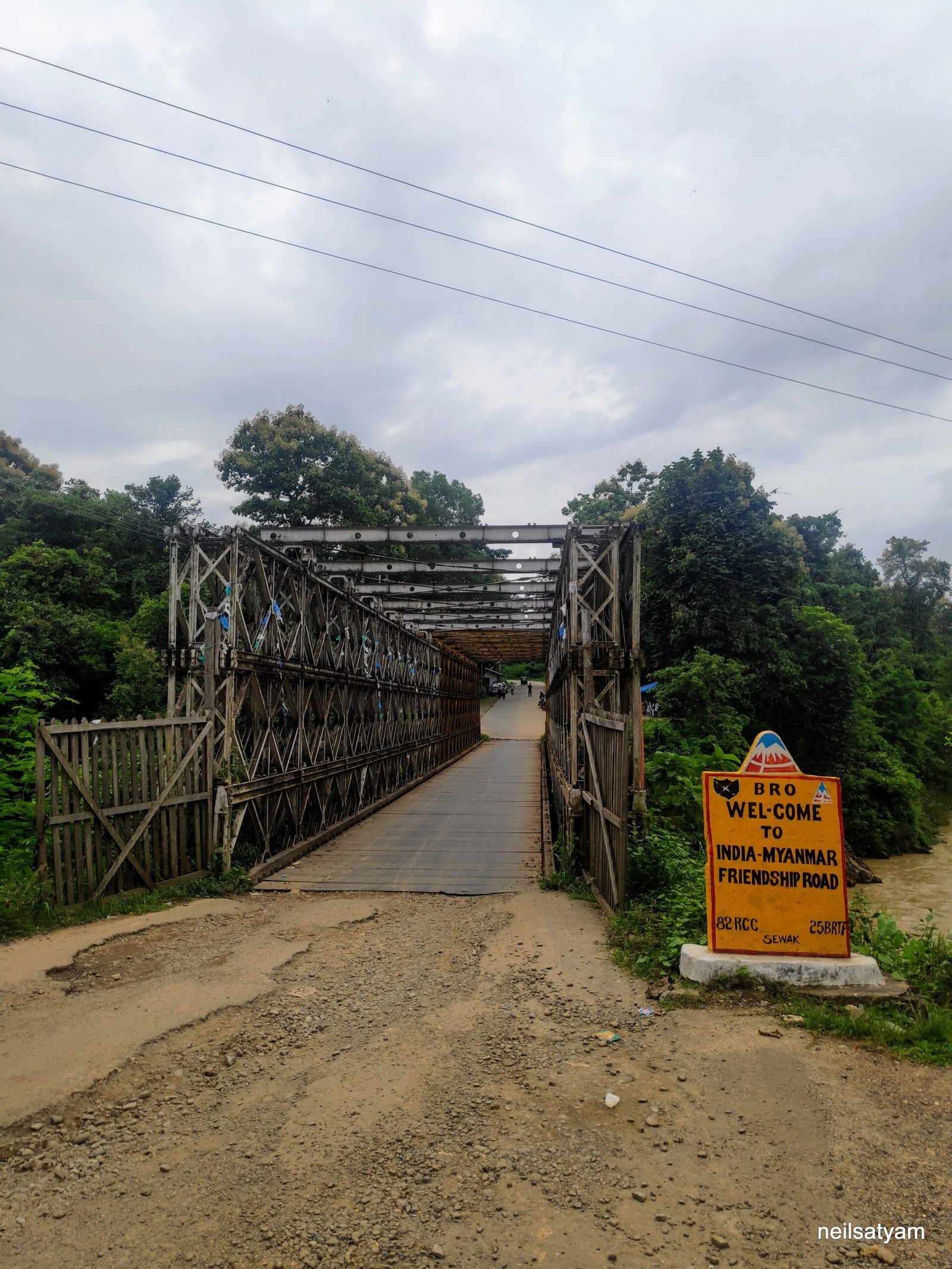
A Bailey bridge over the Namban river that served as the only road lifeline for more than ten villages in Manipur’s Kamjong district was destroyed in a suspected explosive attack on the night of July 21–22, cutting off the Sahamphung block from Kamjong district headquarters. What happened to the bridge itself is not in dispute. Who did it, and why, is — and that dispute has now reached the state’s home minister, who told reporters this week that two competing explanations are circulating and that neither has been officially confirmed.
What is established. The bridge — a 130-foot Bailey structure built in 2016 under the Pradhan Mantri Gram Sadak Yojana, connecting Kamjong district headquarters to Sahamphung via Chatric Khullen and Chatric Khunou villages — collapsed at its midpoint after an explosion residents in the area heard between roughly 9:30 and 10 pm on July 21. This detail is corroborated independently by at least two separate reporting efforts: Imphal Times, relaying statements from Naga civil society bodies, and EastMojo, which spoke directly to a local village headman. A Telecom Department vehicle travelling toward Chatric village was separately set ablaze, according to both accounts. Kamjong police confirmed a team had reached the site and opened an investigation; no group has publicly claimed responsibility.
Where the accounts diverge. Two Tangkhul Naga civil society bodies — Khanuithot-Khon (Voice of the Naga Youth) and the Tangkhul Naga Long (TNL) — went beyond describing the blast to naming a culprit. Khanuithot-Khon specifically alleged the bridge was destroyed by “Kuki narco-terrorists” acting with the assistance of Assam Rifles personnel. The TNL alleged a coordinated attack by Kuki militants in collusion with the Kuki National Army-Burma (KNA-B), tying it to a broader pattern it says these groups have carried out from villages including Kultuh, Phaikoh and Molnoi in recent months.
Sentinel NE Desk’s own cross-check of independent, non-advocacy reporting found a materially different picture. EastMojo’s own correspondent, reporting separately from the two Naga bodies, quoted Stephen LM, the 70-year-old headman of Chahong Khunou, describing how armed groups could plausibly have approached the bridge undetected through hill and riverine forest from the direction of Phaimol, a Kuki village he said was destroyed earlier in the conflict. That account attributes the likely route to Kuki militants — but, notably, does not mention any Assam Rifles involvement at all. The allegation of a Kuki-militant attack has some echo in independent, on-the-ground reporting; the specific allegation of Assam Rifles complicity does not, and appears confined to the Khanuithot-Khon statement.
The government’s own position: unresolved. Asked about the incident on July 23, Manipur home minister Govindas Konthoujam told reporters that “two different versions” of the blast had emerged — one alleging involvement by people from outside the country, the other claiming the attack was intended to disrupt the movement of Assam Rifles personnel — and said explicitly that neither was an official finding and that the matter remains under investigation.
Context: a documented, pre-existing grievance. It’s worth noting, for readers assessing the collusion allegation, that it does not arise from nowhere. A week before the blast, a joint security team including Assam Rifles conducted a combing operation in three Tangkhul villages in the same Ukhrul-Kamjong belt, detaining four residents whose whereabouts the TNL said were briefly unknown; the TNL protested at the time that Kuki villages it considers the epicentres of the area’s violence had not seen equivalent operations. That grievance is a documented, recurring theme in this area’s civil society statements over 2026, independent of this specific allegation. It helps explain why this community’s advocacy bodies would be quick to suspect security-force complicity here; it does not, on the evidence found, establish that complicity actually occurred.
The allegations that Kuki militants carried out this attack, and that Assam Rifles personnel assisted them, originate solely with Khanuithot-Khon and the Tangkhul Naga Long and have not been independently confirmed by security forces, police, or other press reporting reviewed at publication time. This article will be updated if investigators release findings.
The allegation that Assam Rifles personnel assisted Kuki militants in this attack originates with a single civil society statement as relayed by one outlet, and was not repeated in an independent, on-the-ground report that separately attributed the likely attack route to Kuki militants without mentioning security force involvement. Manipur’s home minister has publicly stated the cause remains under investigation and that no official version yet exists.
How we verified this story
- Confirmed independently (advocacy-sourced reporting plus a separate EastMojo report with a named local source): the bridge’s destruction, its date/time, and its impact on Sahamphung block.
- Confirmed: Manipur’s home minister has publicly acknowledged the cause is disputed and unresolved as of July 23.
- Confirmed via a separate July 15 EastMojo report: a documented, pre-existing grievance in the same villages about uneven security-force conduct, providing context (not proof) for the collusion allegation.
- Not corroborated outside a single advocacy statement: the claim that Assam Rifles personnel assisted in the attack.
- Open question, unanswered in the public record as of writing: whether the “conflicting reports” the home minister referenced include or exclude the Assam Rifles-collusion claim specifically, or whether that allegation has been examined at all by investigators.