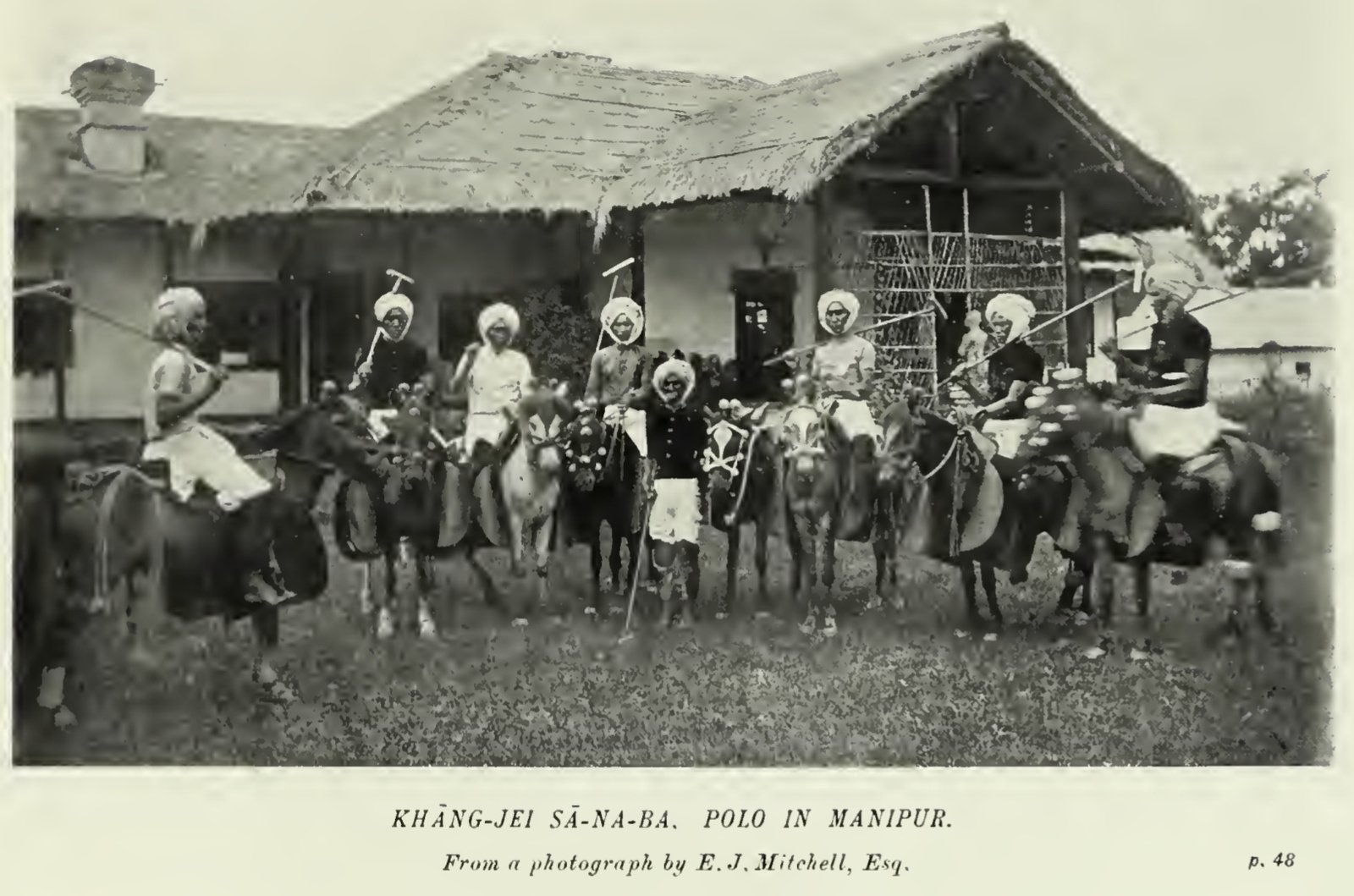
Long before “polo” entered the English sporting vocabulary, Manipur had Sagol Kangjei — a game played on horseback with a long-handled stick, its name built from two Meitei words: sagol, meaning horse or pony, and kangjei, meaning stick. Local tradition ties the name to Kangba, an early king remembered in Meitei oral history, and the game is woven deeply enough into Manipuri identity that Meitei mythology casts the deities Marjing and Thangjei as its first players.
How old the game actually is remains a matter of local tradition rather than settled historical record — some accounts place its roots in the ancient Kangleipak kingdom, though such dates cannot be independently verified. What is documented is the game’s role in Manipuri public life for generations: it carried royal patronage, doubled as cavalry training, and was central enough to community life that a popular local saying held that men would pawn their wives’ jewellery to buy a pony for the game.
The documented turning point came in the 19th century, when British officers posted in Manipur encountered Sagol Kangjei and adapted it into the modern game of polo, which they then carried to other parts of India and eventually the world. Imphal’s Mapal Kangjeibung ground is widely cited as one of the oldest polo grounds still in use anywhere.
Sagol Kangjei is still played in Manipur today, in a form recognisably close to its traditional rules rather than the modern sport it helped spawn. For a state whose contemporary headlines are dominated by conflict and disruption, the game remains one of the clearer threads connecting present-day Manipur to its older civic and cultural life.
Compiled from:
Claims about the game’s exact age and mythological origins reflect local tradition and oral history, not independently verified historical fact. Sentinel NE will update this report if new scholarship emerges.
Image: “Sagol Kangjei – Polo in Manipur,” photographed before 1908 by E.J. Mitchell, published in T.C. Hodson’s “The Meitheis” (1908). Public domain, via Wikimedia Commons.