Every July, once the paddy has been sown and the monsoon has settled over the Jaintia Hills, the town of Jowai in Meghalaya turns its attention to an older calendar. For four days, the Pnar, or Jaintia, community observes Behdeinkhlam, a festival whose name translates roughly to “driving away the plague,” and whose rituals are still performed largely as they have been for generations, according to the Meghalaya government’s official tourism portal and accounts compiled on the festival’s history.
The festival’s origins are tied directly to disease. Oral history and heritage accounts trace Behdeinkhlam to a period when cholera outbreaks devastated the Jaintia Hills, and the rites were developed as a communal appeal to be spared future epidemics. “Beh” means to drive away and “khlam” refers to plague or pestilence, a naming that still shapes the festival’s central gesture: young men moving through Jowai’s neighborhoods, beating the roofs of houses with bamboo poles to symbolically expel sickness and misfortune from every home.
The most visible preparation is the construction of “rots,” bamboo and paper structures that can rise 30 to 40 feet, built by youth from different localities of the town in the weeks before the festival. Far from being purely decorative, the rots are used to comment on contemporary concerns, with past structures referencing everything from environmental protection to major sporting events, giving the festival a running commentary on the year’s social and political life even as it enacts a centuries-old ritual calendar.
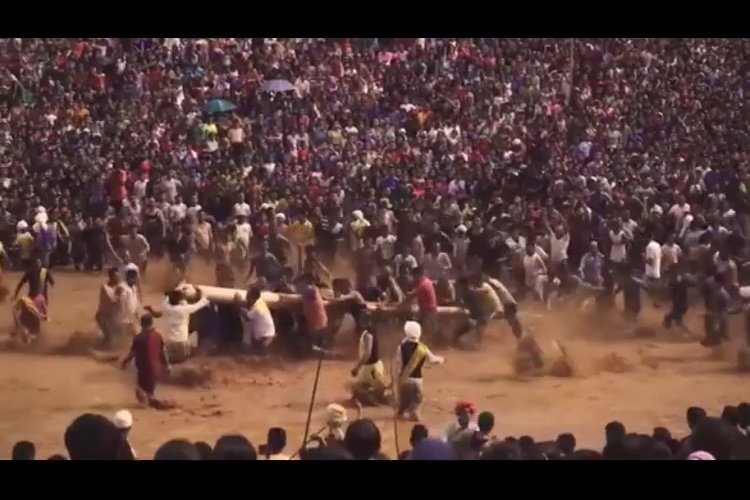
Religious authority during Behdeinkhlam rests with the Dolois, traditional priests of the Niamtre faith practiced by the Pnar community, who lead offerings to ancestors and clan deities over the course of the festival. Central to the rites is the “Khnong,” a large, straightened tree trunk felled from the forest and carried into Jowai with considerable ceremony; touching it is widely believed to confer protection from illness and better fortune in work and business, a belief strong enough that crowds gather simply for the chance to reach it.
The festival builds toward its climax at Aitnar, a sacred pool at the heart of Jowai, where the rots and the Khnong are ceremonially immersed in mud, accompanied by mass dancing to drums and pipes. Two teams also compete to drag a large, undressed wooden beam across a muddy channel known as Wah-eit-nar, a contest that descends into good-natured chaos as participants smear each other with mud. Women take no part in the dancing itself, a distinction preserved in every account of the festival, but hold a separate and essential role, offering sacrificial food to the spirits of the forefathers throughout the observance.
Behdeinkhlam closes with “dad-lawakor,” a game resembling football played with a wooden ball between teams representing the upper and lower stretches of the Myntdu river valley. Tradition holds that whichever side wins secures a more bountiful harvest for its area in the year ahead, folding a contest of sport directly into the festival’s original purpose of praying for agricultural abundance.
The Meghalaya government recognizes Behdeinkhlam as a gazetted public holiday, and state officials, including cabinet ministers, have attended the Jowai celebrations in past years, a reflection of the festival’s standing as one of the state’s most significant expressions of indigenous identity. For the Pnar community, the four days in Jowai remain what they have long been: not a staged performance for outsiders, but a living request, renewed annually, for health and a good season ahead.